projectLSA







projectLSA is an R package that provides a complete graphical user
interface (GUI) for conducting Latent Structure Analysis
(LSA) through a Shiny application. It integrates multiple
latent variable methods, including:
- Latent Profile Analysis (LPA)
- Latent Class Analysis (LCA)
- Latent Trait Analysis (LTA / IRT)
- Exploratory Factor Analysis (EFA)
- Confirmatory Factor Analysis (CFA)
All analyses can be performed without writing any
code, making the package accessible for researchers, students,
and applied analysts.
Installation
# Install from CRAN (when available)
install.packages("projectLSA")

# Install development version from GitHub (optional)
remotes::install_github("hdmeasure/projectLSA")
Launch the Application
library(projectLSA)
run_projectLSA()
This opens the full Shiny application, including all LSA modules,
data upload, built-in datasets, interactive plots, and reporting
features.
Video Tutorial
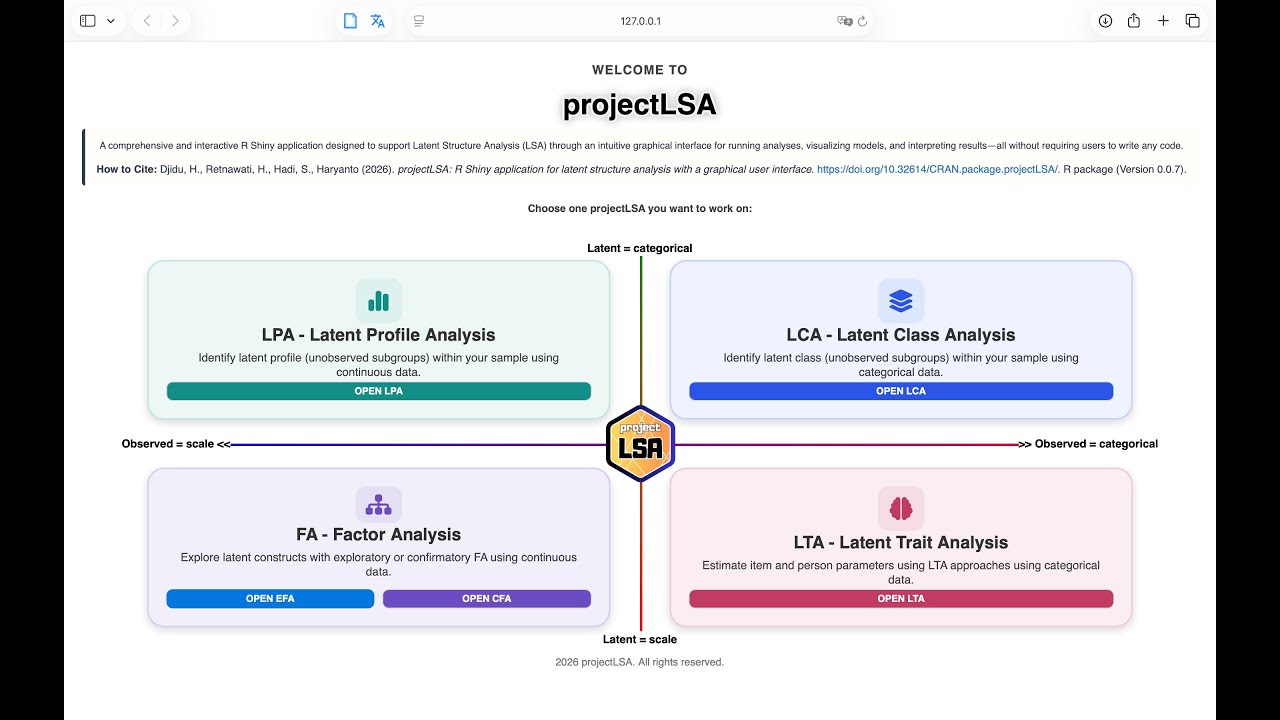
🎬 Click the image to watch the installation and quick-start
tutorial for projectLSA.
Features
✔ Latent Profile Analysis
(LPA)
- Upload your own dataset or use built-in examples.
- Fit multiple LPA models automatically.
- Compare AIC, BIC, entropy, and class size.
- Visualize the best model with customizable class names.
✔ Latent Class Analysis (LCA)
- Supports categorical indicators.
- Fits multiple class solutions.
- Interactive plots with ggiraph.
- Probability tables and class membership export.
✔ Latent Trait Analysis (LTA /
IRT)
- Supports dichotomous and polytomous items.
- Automatically fits Rasch, 2PL, 3PL (or PCM/GRM/GPCM).
- ICC plots, test information, factor scores.
- Test information, marginal reliability, and conditional standard
error of measurement.
- Differential item functioning (DIF) analysis with anchor-item
selection.
- Score new respondents from a fitted model using a downloadable Excel
template.
- Multi-dimensional visualization with 3D surfaces and heatmaps.
✔ Exploratory Factor Analysis
(EFA)
- KMO, Bartlett test, parallel analysis.
- Factor extraction with rotation.
- Factor scores and loading matrix export.
- Data summary visualisations and composite-variable calculation.
- Score new respondents from a fitted solution.
- Clean HTML summaries for clearer interpretation.
✔ Confirmatory Factor
Analysis (CFA / SEM)
- Lavaan model editor with a built-in methodological guide.
- Fit measures, loadings, factor scores, AVE/CR, and HTMT.
- Ordinal data option for categorical estimators
(WLSMV, DWLS, ULS, …): indicators are modelled from polychoric
correlations and thresholds.
- Modification indices with an editable model-comparison history.
- Multi-group CFA with configural, metric, scalar,
and strict invariance testing, plus a one-click automated all-levels
comparison.
- Latent growth modelling via
lavaan::growth().
- Data summary visualisations, composite-variable calculation, and
scoring of new data.
- Fully customized SEM path diagrams (full model or structural model
only).
✔ A clean HTML interface
- One layout for every method: the sidebar lists the methods on the
home screen and turns into the method’s own sub-menus inside it.
- Built for working with data: the sidebar folds to an icon rail, and
every options panel can be folded away.
✔ Save & Restore Analysis
Sessions
- Every module can save the whole analysis session (data, fitted
models, and settings) to an
.rds workspace file.
- Reload the workspace later by uploading it as the data source and
continue where you left off.
✔ HTML Reports
- A report form with Write with AI on every part
(background, objectives, method, interpretation, conclusion,
limitations).
- Every module renders an R Markdown report that you can preview
in-app before downloading.
- Reports embed the underlying R console output and, optionally, an
AI-written summary.
✔ AI Assistant (optional)
- A floating assistant available in every module: ask questions about
the current results, or generate a summary in manuscript, APA 7,
paragraph, bullet, or table format (English or Indonesian).
- Add several models at once: Google Gemini, Groq, OpenRouter,
Cerebras and Mistral (free tiers offered by the providers), OpenAI, xAI
Grok, or any OpenAI-compatible server (Ollama, LM Studio).
- Automatic mode moves to the next model when one runs out of quota;
single mode uses one model.
- Test every model at the same time, switch between them, and edit
model names in place.
- You supply your own API key at runtime. It is used
only for that session, is never stored by the package, and nothing is
sent anywhere until you enter a key and ask a question. The application
is fully usable without it.
Live Demo (Shiny Application)
All features of projectLSA can be explored through
an interactive Shiny web application.
👉 Launch the live application:
https://measure.shinyapps.io/ProjectLSA/
The web interface provides access to Latent Profile Analysis (LPA),
Latent Class Analysis (LCA), Confirmatory Factor Analysis (CFA),
Structural Equation Modeling (SEM), and Latent Trait Analysis (IRT),
allowing users to explore the full workflow without local
installation.
Citation
If you use projectLSA in publications, please cite the following:
Journal Article (primary):
Djidu, H., Retnawati, H., Hadi, S., & Haryanto. (2026).
projectLSA: A Shiny Application for Integrated Latent Structure
Analysis. Applied Psychological Measurement. https://doi.org/10.1177/01466216261446305
R Package:
Djidu, H., Retnawati, H., Hadi, S., & Haryanto (2026).
projectLSA: R Shiny application for latent structure analysis with a
graphical user interface. R package. https://doi.org/10.32614/CRAN.package.projectLSA
BibTeX
@article{Djidu2026projectLSA,
  title     = {projectLSA: A Shiny Application for Integrated Latent Structure Analysis},
  author    = {Djidu, Hasan and Retnawati, Heri and Hadi, Samsul and Haryanto},
  journal   = {Applied Psychological Measurement},
  year      = {2026},
  doi       = {10.1177/01466216261446305}
}
Contributing
Bug reports and feature requests are welcome:
https://github.com/hdmeasure/projectLSA/issues
License
MIT License © 2026 Hasan Djidu