 R package rEMM - Extensible Markov Model for Modelling Temporal
Relationships Between Clusters
R package rEMM - Extensible Markov Model for Modelling Temporal
Relationships Between Clusters
R package rEMM - Extensible Markov Model for Modelling Temporal
Relationships Between Clusters
R package rEMM - Extensible Markov Model for Modelling Temporal
Relationships Between Clusters

Maintainer: Michael Hahsler
Implements TRACDS (Temporal Relationships between Clusters for Data Streams), a generalization of the Extensible Markov Model (EMM), to model transition probabilities in sequence data (Hahsler and Dunham 2011). TRACDS adds a temporal or order model to data stream clustering by superimposing a dynamically adapting Markov chain. It also provides an implementation of EMM (TRACDS on top of tNN data stream clustering) (Hahsler and Dunham 2010).
The package also provides interface classes DSC_tNN and DSC_EMM for
data stream mining with stream
(Hahsler et al. 2017).
Stable CRAN version: Install from within R with
install.packages("rEMM")Current development version: Install from r-universe.
install.packages("rEMM",
    repos = c("https://mhahsler.r-universe.dev",
"https://cloud.r-project.org/"))We use an artificial dataset with four clusters. Points are generated using the fixed sequence <1,2,1,3,4> through the four clusters. The lines below indicate the sequence.
library(rEMM)

data("EMMsim")

plot(EMMsim_train, pch = NA)
lines(EMMsim_train, col = "gray")
points(EMMsim_train, pch = EMMsim_sequence_train)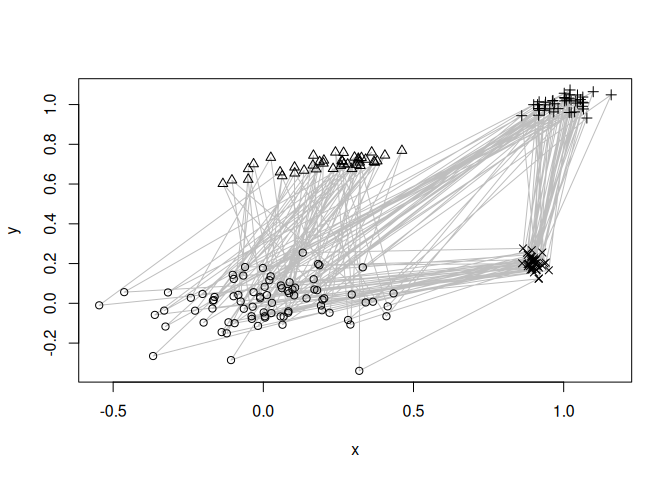
EMM recovers the components and sequence information. We use EMM and then recluster the learned structure, assuming that we know there are four components. The graph below represents a Markov model of the sequence.
emm <- EMM(threshold = 0.1, measure = "euclidean")
build(emm, EMMsim_train)
emmc <- recluster_hclust(emm, k = 4, method = "average")
plot(emmc, method = "MDS")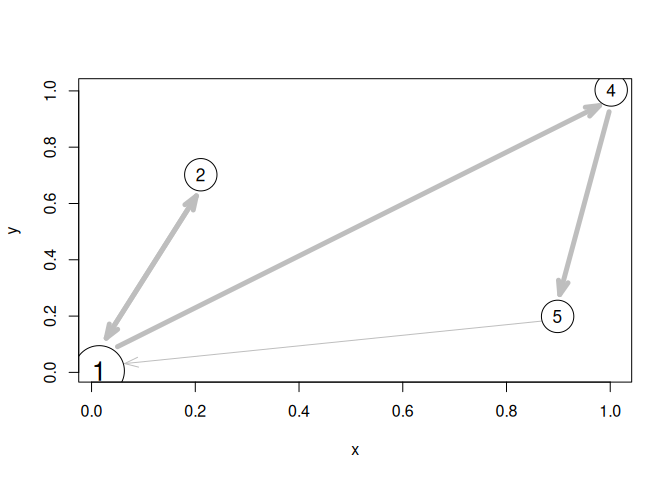
We can now score new sequences. Here, we use a test sequence created in the same way as the training data and calculate the product of the transition probabilities in the model. A high score indicates a good match.
score(emmc, EMMsim_test)## [1] 0.71Development of this package was supported in part by NSF IIS-0948893 and R21HG005912 from the National Human Genome Research Institute.